Friday, 13 December 2019

There is no escaping the national question at the end of empire

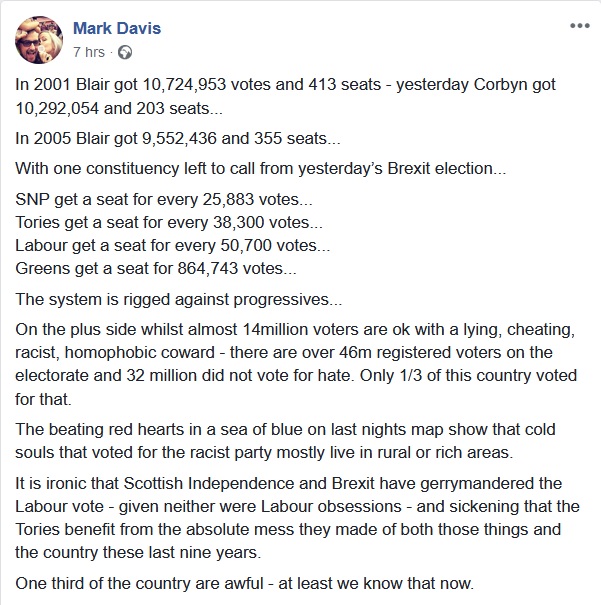
"Scottish Independence and Brexit have gerrymandered the vote"
When England lost an empire it joined the Common Market, screwing over its remaining colonies, as imperial preference gave way to the European market. England had been in parlous financial states and there wasn't the stomach to butcher every colonial independence fighter, or concentrate whole nations into camps, altho they did a bit of that. What they had instead was to be America's European outpost, endlessly diluting European unity with economic liberalism and weakening European consolidation, while peddling arms and latterly mercenaries, affording an outsized geopolitical influence, despite the loss of empire.

What has taken place in England is that that influence has now been destroyed and the actual reckoning of the loss of empire in the post war period is now playing out ideologically. This also happened before, when England stopped including parts of France, there was a big old war to sort it all out and the end up was the Tudors and their piracy and unsuccessful foreign wars that ultimately started to come good for imperial coffers once everyone wanted manufactured goods, and this helped to finance a new wave of genocides and protection rackets, which ultimately led to a hegemonic bloodthirsty empire, which was to see the 20th century be 'The British Century'.

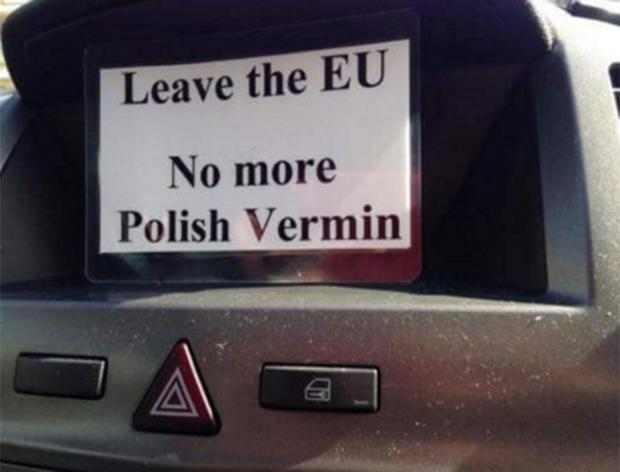
 My takehome from all this historical blethers is that the fascists understand the deep modal forces that underpin this wave of reaction. They've harnessed latent English imperial discourses that the obfuscation of post windrush inclusive "Britishness" made no attempt to reckon with. The national question in England is alive and well simply because for a huge cohort of people, the British empire never ended and restoring the project of whitey global governance in the English language is of absolute paramount importance, trumps all other policy concerns and baked into that set of ideas is also the British imperial system of racism (which differs markedly from American racism, which for some reason the English left is more interested in). This is why we are seeing reports of racist maniacs shouting at black people, but we have a far right British Gujarati MP as Home Secretary leading the charge on official racist attacks.

I described what was going on in England in 2016 as a Nationalist paroxysm. The last one on this scale in England lasted for a generation. We are sat here as bystanders in England's end of empire psychodrama.
 
[not so much about 'racism' as a hierarchy of 'races']
 

Tuesday, 23 January 2018

Why I Am European, #1

HEARD ye o' the tree o' France,
I watna what 's the name o't;
Around it a' the patriots dance,
Weel Europe kens the fame o't.
It stands where ance the Bastile stood,
A prison built by kings, man,
When Superstition's hellish brood
Kept France in leading-strings, man.

Upo' this tree there grows sic fruit,
Its virtues a' can tell, man;
It raises man aboon the brute,
It mak's him ken himsel, man.
Gif ance the peasant taste a bit,
He 's greater than a lord, man,
An’ wi' the beggar shares a mite
O' a' he can afford, man.

My parents are pro-European; today they are semi-retired and divide their time between Dundee and Andalusia.  Growing up in the 80s and 90s, it was always their ambition when they reached retirement to move to rural France to retire.  I think to some extent that was the zeitgeist of aspirational retirement at that time; we certainly listened to a many talking books in long car journeys with just that theme.  Nevertheless they lived the dream as far as they could.  We would always holiday in Gîtes.  Over the years I got to see a lot of rural France.

The first Gîtes I stayed in was in a quiet rural part of Pas-de-Calais, a place with an unusual name, Hermelinghen.  The village then housed an auberge that was rarely open.  Locals said that the proprietor had had a bereavement and was an alcoholic.  It had a kirkyard, and it had the empire of Monsieur Alphonse, an old man who I had few conversations with over three stays in his peasant/capitalist empire.  I was a very young teenager, and my French was poor.  My dad's French however was and remains excellent, so we always knew what was going on.

La Voix du Nord:
Chaque week-end, ils sont des centaines à venir goûter
au pittoresque des trois circuits partant d’Hermelinghen.
M. Alphonse inherited his farm from his father.  It consisted of white grape vinyards which were sold in bulk to the local bodega to be homogeneised to produce a low quality table wine.  It was not hugely profitable.  But there was space, and an ample amount of it.  What he did with it was to demolish one field of the poorest vinyard, and turn it into a caravan and camping site.  Pas-de-Calais is fairly near Paris, so that was a very sensible plan.  The local area is full of beautiful countryside and *very* fine dining  (I've never eaten better than in rural France).  As tourism flourished he used the revenue from this business to transform a number of derelict farm buildings into Gîtes (by British standards Gîtes are highly affordable, with costs per night similar to youth hostels, but they're better, much better, and higher profit than campsites).  As his empire expanded, and he received repeat business, he increased the size of his campsite, demolishing another field.  Now his remaining grape vines were the best ones he had.  He used the money from his burgeoning business to invest in them.  By the time of our first visit he was producing more income from his wine than he had when he inherited the farm, and it was of a quality.  He'd launched a political career, becoming Le Maire.  A man in his 60s, he seemed full of plans.  I'd love to find out what happened to him twenty years later.  I did a search for this article, and while I could not find much out about him, I found Hermelinghen is at the centre of a major rural cycling route that's recently been established.  I wonder if he or his progeny had a hand in it?  The peasants of France really can make a kirk or a mill o it.

I'd studied the French Revolution in primary school.  Our primary school in Dundee, Craigiebarns, had a head teacher who was an ex operatic singer.  We were chosen to perform a piece by the Scottish National Opera.  We trained for what seemed like forever.  I played the role of one of the new patriot soliders.  We sang La Marseillaise.  This gave me the frame of reference as a young lad to understand quite why a farmer in rural France could have the opportunities Scottish farmers can't afford to dream of.  Geography at school and a focus on rural development and human geography and diversification and the barriers faced by tenants provided another piece of the puzzle.  As the years went on I visited much more of rural France and many, many Gîtes.  I will always be grateful to my parents for this.  It is an anchor of my European identity.  As well as teaching me about rural life in a warmer, much much freer country, it also taught me a very great deal about international affairs and Scotland's position as a colony, which in better days once played a far nobler role in international affairs.

I recall when we rocked up to a Gîte in Picardy, in our clapped out white Peugeot saloon car, with family friends Carol and Steve, the proprietor, behaving rather stuffily showed us how various metres and appliances worked.  He was quite perfunctory, and somewhat dour, almost miserable, with warnings and so on.  Walking across the courtyard, back to his farmhouse rather quickly he wished us a pleasant stay until our return to England.  We told him we were Scottish.  He stopped, and turned around.  His face melted.  He came forward to greet each of us, smiling.  At once he insisted we attend his house tomorrow for a soiree.  It was night and day.  I recall the soiree itself with great affection.  The language barrier made the occasion more about body language and facial expression, as only my dad was fluent in French.  Nevertheless it was a genuinely pleasant and hospitable experience, and we considered it an honour. I was still quite young, but to see this dour hulking proprietor transformed into a friendly diplomat is a memory that will live forever in my mind.  This is a legacy of Scotland's role in international affairs, particularly as *good Europeans* a role we have not had for 310 years.  It remains able to make dour men smile.

I can and will bang on about this point, because I have this experience more times to remember since then.  However we need to remember we are a country which embraced Europe more fundamentally than most of the pro-EU countries in the EU, just as our 'compatriots' in England embraced ultra Nationalism, race hate and myths of superiority and dominion over others.  Just because we are lashed to England by forces of our own self-doubt promulgated by our own domestic reactionaries, as England travels down a reactionary path towards humiliation, xenophobia and self-destruction, we must never forget that *we are Europeans*, first and foremost.  We are not servile little sub-Brits who hate the world.  I hope one day our English brethren can dispose of their superiority complex and embrace their position as a leading European economy, and a country long linked to France, Rome and the Baltic states, but the best way we can encourage this sensibility is by leading the change.  We are the world, and all men are brothers.  Globailisation and universal brotherhood has been the national mission of the left in Scotland ever since we began to try to undo our semi-colonial status.  The seed of rebellion in Scotland is the seed of the Tree of Liberty.

Then let us pray that come it may,
(As come it will for a' that,)
That Sense and Worth, o'er a' the earth,
Shall bear the gree, an' a' that.
For a' that, an' a' that,
It's coming yet for a' that,
That Man to Man, the world o'er,
Shall brothers be for a' that.
Monday, 21 August 2017

My thoughts on the main issues for the YES movememt

Three things;

1) Some people think raising taxes and nationalising things is what makes something left wing. This is simply untrue. The left seeks to change the political economy of society to empower workers. That's why the Salmond era SNP government was to the left of the Sturgeon one, even tho the present government has shown willing towards nationalising, raising taxes and increasing social welfare. Money is made, then taxed, then spent in that order. What matters is the first bit. Nobody is going to be very impressed with an economy based on rentier capital with high degrees of economic insecurity just because the trains are publicly owned or the social welfare provision is improved, because everyone in the shit has no hope and no future of economic security. To fundamentally change that is a question of *industrial policy.*  It is about moving away from a rentier economy.

2) A lot of people who consider themselves socialists seem to have drank the koolaid. They believe that tax and spend and doing unpopular things for totemic reasons are urgently important. The SSP used to have this ludicrous doctrine that pursuing 'a battle of ideas' was a more important focus for its activism than whether the economy is unionised, whether workers have power. At their height they had 3000 people which they used to promote ideas. As a result they have lots of brand recognition still, but they did not create any powerful residents associations or develop the unions, altho some individuals within them did, no thanks to their potential power as an organisation. The much larger and more powerful SNP has never set itself up as a socialist party, and official party ideology is in favour of 'social partnership' as a social democratic party. This works both for reasons of pro independence expediency which requires a broad based movement to secure victory in a vote, and based on the Nordic model and idea that more equal nations are better for everyone, which sits well as a fudge between Nationalists, social democrats, liberals and socialists. There is however little appreciation that social democratic parties only tend to do well when socialists are pushing an economic programme, as that is liberating for those at the bottom of the pile in unequal societies, allowing them to do a 'reverse Blair' and expand rather than contract the electorate.  Politicians schooled in 90s era political calculus seem to have little appreciation of this, and as a result have been blindsided by the role of socialists in England of late. For many liberals the general ideas of the 'gang of four' in the 1980s, that socialists have 'gone too far' and so on are accepted as political gospel. Socialists in turn have tended to see this as 'the radical centre' trying to enforce neoliberalism against the will of the working class. However, because many socialists have drank the koolaid, what they propose as a remedy is redistribution and doing things that nobody sensible would advocate, such as behaving like a government of protestors.

3) A fixation on the headline employment rate has been seen as a sensible focus or a proxy for addressing working class concerns about insecurity. In the post cold war era it was widely believed that nothing could be done to address deindustrialisation, but if folk were working and so on, they would not be 'excluded'. This idea has morphed into something else, as the Tories have destroyed the welfare system, while a rentier economy has expanded relentlessly. Now that the headline unemployment rate is low, the idea is that we have somehow limited or tamed misery. We have reached an increasingly fair society. I suppose it is much easier to believe this if you considered the 90s/00s focus on tackling social exclusion as a matter of finding work to be sensible, and also if you don't live in an area of 'social exclusion'. I do, and frankly the idea that someone working in insecure employment where they can be asked to work unpaid overtime, work shifts during their scheduled childcare, and be endlessly "flexible", in order to earn a wage where they can never hope to retire or amass any savings or advance themselves and their family, that somehow this is a success is insulting. This is why industrial policy is at the root of what it is to be left wing. If the economy is one in which workers have no power, this can never be "full employment": a far better measure of success on that front is whether wages and conditions are improving for workers. There are practical limits to what workers in the service sector can achieve in terms of civilising the companies they work for. There are also severe problems for trade unions organising in that disrupting the sale of produce of somewhere else is difficult and likely to have limited effect on raising standards of pay and conditions for workers elsewhere.

Sunday, 20 August 2017

The orginal set up (failing rubber plant)

The original set up
The bit I kept for a cutting

What is left

Thursday, 27 July 2017

Lexit, and the left embrace of facist, Nationalist and nativist politics

Fighting neoliberalism!  Distilling the core message.
This week my mother in law got her Irish citizenship thru. Both my mother and father in law have a long relationship with the Netherlands. My mum and dad have recently bought a home to retire to in Andalucia. My auntie and uncle retired to Spain 15 years ago. My cousin lives there too. I have several mates who live in the rest of the EEA. My next door neighbour is an Irish Belgian. A number of my comrades, neighbours and friends are rEEA/EU citizens. I have been a socialist since I became an adult.

I have visited or passed thru most of the countries in the EU. I have never once considered myself British - as a state, I've always felt the United Kingdom is a compound colonial crime. This to me seems as simple and logical as breathing air, or rolling my Rs - why would I want to be trapped here, if there is no progress on Scotland becoming a democracy?

A popular movement for hard Brexit?
I have long been interested in, as a result of being Scottish, and trying not to be a complete idiot, how a polyglot society can have a monoglot world view stamped on it by state power.

The EU has played an important role in fighting back against Nation state imperial Nationalist chauvinism towards sub-state nation and regional and minority languages. It helped, alongside a longstanding popular movement, to cajole the UK into adopting devolution against a Prime Minister in Tony Blair who deeply resented the idea.

Some more #Lexit.
Today we see very clearly in the starkness of the Brexiteering scions of society: they are the shits - the Tories, the racists, the 'no to indyref2' bottom feeders, who in Aberdeen, seek to wreck Aberdeen, because they despise the poor, despise change, despise foreigners.

These people have presided over the biggest rise in hate crimes in recorded history. They have terrorised minorities. They have described 3,500,000 or so people living here in this state as "immigrant labour" - the party which claims to represent labour has been most forceful in explaining that they are the reason employers have lowered wages, casualised industries, jeuked social responsibilities, attacked collective bargaining, and swicked the taxman and their employees out of countless millions that they have given shareholders, but it's the workers fault the party of labour say. Just like it is women's fault they entered the workplace, and lowered wages (I heard nobody say, yet)?
Some more of the progressive consequences of #Lexit
And in so doing they have empowered the most right wing political movement since Enoch Powell's rivers of blood speech set loose a very similar reactionary movement, and their supporters have not so much whimpered a note of contritibn.

Indeed they think attacking and destroying the lives and plans of millions is an entirely honourable thing to do, because many workers back them. And many of those workers are salivating at the entirely inaccurate idea that if they sack and deport the "immigrants" those jobs would go to "the native born".

Who will listen to the forgotten white working class?
I'm sickened by it all. What sickens me most is that people who claim to be socialists are gravitating more and more to ideas which an gramme of backbone would ensure they'd never countenance.

Apparently the EU is neoliberal, the single market is neoliberal, freedom of movement is neoliberal, so a neighbour, a comrade, a friend, a colleague - their existence is neoliberal. So they'd back a nativist movement whose core ambition is 'repatriation' (ethnicly cleansing the UK) because they've told themselves a childish morality tale sufficient in black and white thinking that they are unable to recognise all these millions of souls that they are desperate to do harm to as somehow fully human like them, with lives, families, futures and needs.

More opposition to neoliberalism!  Fab.
Not only that, these "comrades", these "socialists" have done this during a febrile time of the rise of the right, just this weekend backing the party of "labour"'s attacks on migrants which were tactically designed to put clear xeniphobic water between them and the Tories on free movement, bouncing the Tories into a more extreme anti-immigrant position this week.

So much for the left wing opposition - they are acting more like a right wing ginger group, riding a wave of populist resentment against immigration, forcing the right wing coup that has taken the Tories into ever more extreme positions. I have come now to the point where I literally cannot stand 'the left' and their rudderless ambulance chasing, they venal inability to recognise international political, diplomatic and economic complexity and interdependency, or above all their total inability to parse the politics of the situation or seek and cite historical example.

And if we send them home, then the bosses will be nice
to the workers again, wages will rise, and there will be
jobs for all.  That's totally how capitalism works, right?

They are helping to lead us all into state and a society the likes of which Enoch Powellites would have considered a great victory. They have airbrushed out the fascist assassination of a pro-immigration MP.  They have ignored, minimised or explained away a massive rise in hate crimes, an imperial dismissal of Scottish and Irish democracy.  They have collapsed a peace process in Ireland.  They have legitmised the terrorism, attacks, and indeed murders that many vulnerable minorities have experienced as a result of this 'movement' they are tagging along with. The worst part of it is that they cite that the 'native working class' is for this, and so that means it's progressive, as if that same 'native' working class was up in arms and universally protesting about imperialism, chauvinism and genocide in this fousty empire's glory days.

Saturday, 30 July 2016

On today's Yougov poll and the predicament of the Anglo-Scottish Union

The Yougov poll today about the Union.
1. Concern about yougov poll, and oversoon elation from terrified British nationalists. Poll shows a rise in support for independence, asks if vote were held tomorrow (we know Scots want to wait until they know what Brexit means and any deal on the table for Scotland from the EU is available as a counterpoint), excludes 16-18yos, does not have a correct % of EU nationals, and is weighted on the EU referendum (where we know embarassed LEAVE voters claim they voted REMAIN). Poll shows SNP voters are most likely to change views against independence if it's UK vs EU. Petulent essentialist nationalism that will collapse in a campaign, when independence is on the table. Nonetheless poll shows a rise in support for independence, before a campaign has begun.

2. Until Brexit the logic of strategists was that the SNP could not afford to lose a second independence referendum as it would risk killing the issue for a goodly while. This was broadly true, but only in the context of the life of a Westminster 'long regime' type of government. The issue can never go away completely while Scotland exists, and never has. But this logic is now dead. Were Scots to vote NO in a year's time, it would not be by an enhanced NO, and it would continue to tear lumps out of remaining institutions which support the Anglo-Scottish Union. It would also likely be on a false prospectus of the UK offering continuity and stability in uncertain times. Five to ten years of post Brexit collapse of England's empire, and the knock on effects of this, plus demographic change (the children of YES voter millenials getting a vote, less entrenched baby boomer British nationalists about) would surely trigger the world's biggest 'I told you so,' particularly as the Tories stay in power and England moves to the right, and people discover what having your citizenship and rights ripped up and economy destroyed by a foreign vote actually means for them.

3. Thirdly and most fundamentally of all, the vote on the 23rd of June to destroy England's empire in a last gasp of xenophobic exceptionalism killed the empirical basis of the Anglo-Scottish Union. The impact of the EU vote was never fundamentally about public opinion. It was about elite opinion. The Anglo-Scottish Union is not a British nationalist project. It is an alliance of ruling classes. For the Scottish ruling class the Anglo-Scottish Union delivers (A) continued liberal government, despite working class and labour aristocrat Scots' utter hatred of liberalism. (B) It opens up financial markets thruout the empire, which latterly was buttressed by being the USA's man in the EU (and the various alliances, networks, and markets this afforded). (C) It provides a chance for ruling class Scots and Scots on the make to control the reins of power not just in a small Nordic country, but in a global superpower. By dint of England's successful xenophobic collectivist rebellion, they demonstrated that the era of Union with England guaranteeing liberalism (A) is over. The geo-political effect of this is to isolate England, to fillet its empire, and to cause an unprecedented loss of markets, so that's point (B) over. Plus, with England now effectively in an utterly desperate battle to just stand still as a power, with its economy contracting vis-a-vis the other European empires (and this is before the filleting of Brexit is done and by), does London rule really guarantee a career ladder into a superpower (C), more than being a special daughter of Germany? Obviously our ruling class is integrated into London power networks, but there is widespread talk (even among men such as the Director of Virgin Money) of rapid disintegration being in the best interests of Scottish finance capital for instance. None of this will affect Scottish public opinion, but it is the empirical class basis of the Anglo-Scottish Union, which is now completely dead, unless some British nationalist Bismarck or Napoleon can reforge and repurpose this ruling class deal. Theresa May is not that person. 

Thursday, 28 July 2016

The facebook post detailing James Nebitt's assault of me, which Nesbitt or friends had removed from facebook by autocomplaint

I posted this post to facebook.  It was removed around 3am on the 29th of July by Facebook for a "violation of community standards."  As it contained no spam, or links this must have been as a result of a report by a facebook user that the content was malicious or whatever.  Here it is again, on a blog.

I've just been assaulted in the street, leaving the offlicence after leaving the gym at Charing Cross by James Nesbitt, the original leader of the socialist group, A Thousand Flowers. He came at me saying, "What have you been saying about me? You been saying I raped my ex girlfriend, have ye?" Before swinging wild punches at me. He clocked me on the nose and the left eye. I brought him to the ground and he nutted me from the ground, as I tried to dissuade him of his nonsense. Nesbitt has a conviction for knife crime I believe, so I was a bit cautious with going at him. I assured this foolish man that I have not been claiming he raped his ex girlfriend, and that I couldn't care less about him. When the foolish man appeared to come to his senses I let him up again. He immediately tried to attack me again, and I had to bring him to the ground a second time. I held him there pinned for a while, to make it clear to him I am a good deal stronger than him, altho I didn't hit him, in part because I was a bit concerned he might be carrying and so I wanted to know where his hands were, and in part because he is a very silly man and I just want to go about my business and not get dragged into silly people's blood feuds, and by pinning him to the ground twice I think I made my point. This man James Nesbitt is a danger to himself, as well as to others around him. For the record I have no idea whether he raped his ex girlfriend, and have never heard this claimed. He does assault people in the street based on flimsy rumour tho, so do be careful folks. What a silly man.

Wednesday, 30 March 2016

Unionism's intractable strategic impasse

I'm just back from a work drive and caught a swatch of the (30/03/16) John Beatty Show on BBC Radio Scotland. I normally don't mind that, so listened in. Topic of the day was some haivers about boxing, but mostly (following last night's Leaders TV debate on STV), '18 months on since the NO vote, has Scotland "failed to move on" from the referendum.' Hilarity, in soft Unionist hand wringing. Very enjoyable Schadenfreude at the anti-democrats' pain. 'Can't we all just get along, under the Tories, people?' LOL. 


There are two fundamental and catestrophic political problems for Unionists and Loyalists.

Add caption
One; while Unionists remain divided between umpteen political parties who nonetheless all (in Scotland) agree on monetarist economics but are divided by their respective ultra-sectarian voting supporters and by their real differences in actual power blocs in the provincial Establishment, any fragile majority they may, or may not, have cannot hope to convert to governmental power. This leads to the SNP gaining support among people who might actually be considered among their natural supporters, based on other policy offerings and their unity and credibility.

Two; their problems are primarily English. The line about black holes and ra ra ra Kevin Hague-ry - that only works if the ordinary people feel they are getting a better deal than they would with self-rule. You can't square that with an English politics utterly obsessed with financialisation and totally unprepared to buy off rebellious provinces, because it has become insular and xenophobic to the extent of self-harm to its own imperial status/apparatus. The Highlands of Scotland were converted to hydro power under the threat of just such a situation that we now enjoy in Scotland ever developing; this has happened in Scottish history several times, and Whitehall has found some billions down a sofa to quell any provincial distaste for London rule and desire for Home Rule. Now that more than half of Scotland believes its bread is buttered better with democracy than remote control by a foreign government, and that most people who think like that also want independence, bleating about plugging fictional 'black holes' and other such nonsense is essential a shargart and wabbit challenger frame to those people, and actually *weakens* the case for Union by underlining perceived Unionist parsimony towards the ordinary joe. In order to win some of those people back you actually have to spend some real money, and buy some sectional provincial loyalty. English politics essentially prevents this being possible.

Tuesday, 1 March 2016

A suthfast story? þat be nocht bot fabill: the myth o the Anglo-Scottish Union

"Storyß to rede ar delitabill,
suppoß þat þai be nocht bot fabill,
þan suld storyß þat suthfast wer,
And þai war said on gud maner,
Hawe doubill plesance in heryng.
þe fyrst plesance is þe carpyng,
And þe toþir þe suthfastnes,
þat schawys þe thing rycht as it wes;
And suth thyngis þat ar likand
Tyll mannys heryng ar plesand.
þarfor I wald fayne set my will,
Giff my wyt mycht suffice þartill,
To put in wryt a suthfast story,
þat it lest ay furth in memory,
Swa þat na length of tyme it let,
na ger it haly be forȝet."

[Beuk Ane o John Barbour's The Brus, wrutten in the 1370s]

John Barbour commences the first gret beuk in the Scots leid wi the lines abuin, and while it's no aften quotit, in place o his threip anent freedom, or the bits fae the action, it is dootless ane o the maist thochtie pairts o the epic, an epic that hitsel is written aince errant forderin the Scots national myth wi political ingyne. The stories (or "history" - same word) that we tell wirsels is aye fochen ower acause historicity is an unca political thing, "storys that suthfast wer[...] Have doubill plesance in heryng[...] suthfast story[s ...] lest[s] ay furth in memory / Swa that na tyme of lenth it let / Na ger it haly be foryet." Ane o the important stories we tell wirsels theday concerns the wey we consent, or consentit, tae be ruled, and the creation myth o the UK. Aw states has thir stories and they yoke tae the fang o thaim for tae cleck a guid deal o legitimacy fae thaim. Scotland in Union has ane, and we aw ken it. What tho if soothfast, jonick, richt stories is pleasin tae hear, does it mean gin this important ane turns oot tae be just a swick - a dooble and fenyit, sleekit tale devised for the ettle o keppin fowk fae speirin questions at thaim that's tae benefit?

It's an unca thing that for hunders o years, efter the end o 'parliament and stateheid', Scotland, and the norrie o sic o place, was aye livin and lifelike on accoont o the institutions that beirt the name, the body o law, the Kirk, the lawvyers and the adaes o regulation and commerce - that the interests o thaim aw (or sindry) didna aye marra wi that o the Wastminster state - and syne evenoo "Scottish" cows the gowan in the identity leagues wi "British" yet. Hooandever while thae institutions, that in sae mony weys comprises wir Estaiblishment (whiles in hiddles, whilies crouse and ruisin), for the maist pairt stuid up tae conter an AY vote in 2014 (wi exceptions, o coorse), the'r this myth at the foonds o Union that the Kirk - that in physical form representit Scotland's castin aff o the colonial cheyns o the Valois, the grallochin o the Lords and lichtifiein o the gentrice tae heeze up the ordnar common people - consentit, if no doucely and smertly, but sweirtly and at the hinderend, tae Union on accoont o the Glorious Revolution and the hainin o the Protestant religion.
This was aye a bruckle tale hitsel, takin pelters fae sic wanchancy events as the sindry risins again the monarchy, that whiles had a nationalist character forby. But thaim that skries the story for uisual mints that thae risins was supportit bi wir historic non-Presbyterians. Sae far sae guid - but whit o thaim that embodies the verra sowel o whit and Knox and Buchanan and that was gettin at?

Gin ye've ever been up ower late at nicht playin at youtube for aw the sentimentality yer creeshy-gingerbreid-snashters couthy heid can tak, ye'll mebbe hae taikit ower far intil the warld o fowk muisic, and been scunnered tae come oot the ither side in some kinna Orange Order fiddle band; aside fae synin the lugs oot, and awa up tae yer bed, ane o the maist starkest things is whit legacies they claim fae Scotland's revolution o the 1560s for their ain far richt Anglo-Irish Ulster-Scotchiefied version o the KKK. The'r a affie popular track, The Covenanter Sodger, that's a wee tale o a Covenanter that somewey didna get murdered in the Killin Time, and endit up fechtin for William o Orange. In mauger o yon Dutchman no haein ower muckle tae dae wi knuckle draggin yoons, that their politics actually comes fae a bosses' ploy tae prevent the workers unitin in Erland in the 1800s, the'r a clair and clamant ettle there tae claim the legacy as contiguous wi Union - Croon and Parliament baith.


Ither fowk has dealt wi the Freends o the People, and hoo that the Auld Licht Calvinism o Thomas Muir at the lang and last gart him caw for a Scots Workers' Republic (in the rhetorical freits and laits o the times, raither nor aw raucle and John MacLean like; fowk was hingit for a lot less) but while the 1800s was the beginnin o the end o Kirk pousty that lichtified the maucht o the state, the tradition o absolute Presbyterianism didna dee wi the Killin Times, and Muir was just ane o the inheritors of thae traditions, that was the foonds o his republicanism.

Gin ye ging back forder til the actual Union, obviously the war the republican traditions that Fletcher o Saltoun pushed.
Again he featurs in maist 'gret man' stories, natheless it's kenspeckle that his "12 limitations"*1 (that catalysed the Act o Security, and the Act Anent Peace and War) was the inheritor o the tradition o contractual ("Covenanted") monarchy, and that was ane o the imperatives o Queen Anne *for* Union, tae caw this doon and stop siccan Republicanism fae the Scots parliamentars. Atweel, she was that fashed wi it (and its revolutionary potential), the English Government applied economic sanctions on Scotland, and the Croon wadna approve the Scots' Act o Security ava, and syne the Scots refused tae raise cesses, and ettled tae exit the Croon's war again Spaigne. This period twa-three year afore Union is aften seen as adae wi Jacobites, and syne Unionists aften dooblie peuthers that it was a proxy for the Protestant-Catholic kemp that caws a thrave o Unionist politics; in fact the Scots was gey and clair - while a Stuart King micht be sochten, they'd maun be a Protestant and they'd maun respect Presbyterian laits - they stipulatit in legislation that ye can google gin ye want! History shaws it had deil a thing tae dae wi yon Yoon obsession hooandever as the Act was aboot pittin in place a Protestant monarch, and de facto pittin an end tae the Union o the Croons, wi a Scots economic focus. That was the defence and security reason ahent the English drive for Union here-efter. They wadna coud tolerate sicna independent action, that coud aye end up wi Scotland bein uphauden fae ane o England's tradin unfreends, like the Netherlands, France or Spaigne.  The Act o Security doesna mess aboot tellin the Croon wha's tae be in chairge:

"And it is hereby expressly provided and declared that it shall be high treason for any person or persons to administer the coronation oath or be witnesses to the administration thereof but by the appointment of the estates of parliament in manner above-mentioned, or to own or acknowledge any person as king or queen of this realm, in the event of her majesty's death leaving heirs of her own body, until they have sworn the coronation oath and accepted the crown in the terms of the Claim of Right, and in the event of her majesty's death without heirs of her body, until they swear the coronation oath and accept on the terms of the Claim of Right, and of such other conditions of government as shall be settled in this or any ensuing parliament or added in the said meeting of estates and be thereupon declared and admitted as above, which crime shall be irremissible without consent of parliament." [http://www.rps.ac.uk/trans/1704/7/68]  But tae retour tae thae Orange Yoons wi their happy tunes - whit o the actual Covenanters that wasna drooned, shot or pit tae daith wi a sword? Weel this week the Scotosphere was proggit wi wittins o a kittle beuk, pitten thegither bi actual Covenanters aroond the time o the Union negotiations.

Whit the Covanters has tae say in the Smoaking Flax Unquenchable is this:-
They were again Union;
 
  They considered the Union no legal, and said they had annulled it;

 And that they cawed insteid for a Republic.
 

Noo it's weel seen that aw thir republicans and republican radicals didna beir the gree, and we're aye livin under this pretend democracy but the key preen that hauds aw thir chiels and their thochts, threips and adaes thegither is that contractual monarchy akin til republicanism gings fit for fit wi Presbyterianism. A body canna sinder the twa for tryin as ane (Scots Presbyterianism) is an intellectual strind comin oot o the tither (a revolution again an absolutist and tyrant monarchy, follaed bi anither ane aboot echty year syne), that ye can probably trace back til the maik o Duns Scotus and the Declaration o the Clergy*2 and syne Declaration o Arbroath. That's whitwey the Union o the Croons was necessar for wir Kings, that's whitwey the Anglo-Scottish Union was wrocht tae, acause it gied wir knabberie an inlat tae wrest the fang o pooer and pousty fae the Kirk, and that's whitwey thaim that contered the Union was aw o ae oo whan it cam tae contractual monarchy and Presbyterianism.

Deil a body in a democracy movement is that keen on howkin up anachronistic Presbyterian evangelism. That's no the pynt, but historicity is a gey and important thing. The stories we tell wirsels justifies and richtifies whit we dae theday. Gin it turns oot that the story sae dotit on bi sae monie o the yoons is waur nor a pawkie myth, but is in fact an utter utter lee, wabbit thegither tae deave the sackless fowk and twist the actions and ettles o fowk fae the bygane, whit than? Weel, it'll come as nae gret surprise for democrats tae ken that wir ill pairtit warld and this ill pairtit Union was wrocht bi thaim that wantit tae caw doon democracy, tae stell up monarchy, tae haud the stick ower the ordnar fowk wi mair cesses wi nae concern for their troke or sonse, and tae kep and crine the fang o political pousty for the institutions that stopped the warld gettin mair ill pairtit. That is the hale story o the Union and onie ettle tae stell it up wi convenient haivers aboot maintainin religion, or workin on some religio-moral mission is just tae claivers tae peuther the lugs of yoons.
-- *1: http://bit.ly/1S7Wu1N
*2: http://www.rps.ac.uk/search.php?a=fcf&fn=roberti_trans&id=284&t=trans

Sunday, 9 August 2015

Why YES lost: a reply to Gerry Hassan's claims in the Daily Record

Gerry Hassan writes:-
  • A second Scots indyref is likely but not inevitable. It will only happen when it is winnable, Yes is in a significant lead, and importantly, detailed work has been done to improve and make more credible than last time the indy offer. My Sunday column.(Gerry Hassan on a second independence referendum - 'A new vote on an independent Scotland must be economically honest - not based on fantasy oil prices writes GERRY HASSAN.')

  • Nick Durie This is dishonest, and echoes the Unionist crowing with hindsight. The SNP's projected oil revenues relied on a price that was midway between the OBR projection and the Department for Energy and Climate Change projection. The Daily Record might lap up such Unionist sophistry but the facts say something different.

  • Gerry Hassan Good to know you are thinking Nick; 'Unionist crowing' to point out as someone who voted Yes the limits of SNP indy offer and the complete lack of any post-indyref reappraisal. Yes lost and deserved to lose: welcome to reality.


  • Nick Durie You didn't address my point.
    • Nick Durie You claim that oil projections were a fantasy. Why were they less than those issued by the UK Department for Energy and Climate Change?

  • Nick Durie The fact of the matter is that oil price projections were based on market trends and market fundamentals, and they did not anticipate that Saudi Arabia would flood the energy market to destabilise Russia and collapse US fracking. This was not something the British Government anticipated either, and claiming some kind of post facto foreknowledge while adopting an "It was rubbish" Unionist frame is not the same thing as providing a credible critque. Neither a Scottish currency, nor attempted accession to the Euro is without problems; furthermore neither of those two options does anything to reassure those worried that their savings and investments, denominated in Sterling, would be secure. That was afterall the whole point of the "You're not getting the Pound" frame - to terrorise that cohort that held savings and investments denominated in Sterling. Simply saying 'we won't have Sterling anymore' does not resolve or de-weaponise that attack line; it actually makes it stronger. People were not worried about the future of Sterling in Scotland because of some haivers about central banks. They were worried about their savings and investments.
  • Gerry Hassan Everything about the economics of the indyref offer was a fantasy: oil price, economic projections, currency, Treasury/Bank of England straightjacket. And all only made sense in light of SNP leadership thinking they would lose and instead engage in a vote maximalisation strategy. Then late on they convinced themselves they could win.
    • Nick Durie This is a media bubble argument which owes more to the self-congratulatory discourse of the Unionist commentariat than it does to any extant evidence. The currency strategy was determined by a council of economists, not politicians. The SNP chose simply to follow it; whether their political calculus determined it was good to follow it or not, that strategy was, as you know, written by some very globally notable economists. The oil price was essentially a UK government and Scottish government consensus. The shared central bank is a threat, a gun to the head of Whitehall, and a determination to give the spivs a golden bridge, rather than collapse the London banking centre by immediately denominating Scottish energy in another currency. To claim otherwise to any of that is to fail to engage with the evidence.
  • Nick Durie "Yes lost and deserved to lose: welcome to reality."

    This assumes that the YES offer was why YES lost. I don't think that's particularly materialist. In many ways YES did deserve to lose, but I would argue it lost because the formal YES and SNP camp
    aign concentrated on public relations and fought a very good election campaign, but the depth of citizen engagement with the issue left that approach looking top down and shallow. Citizens were interrogating the question with a zealous seriousness that is not analogous to an electoral cycle contest. The wider mass movement of the YES campaign came to understand that, and had to make up for the shortcomings of the offical and largely corporate style campaign. Consider how much more seriously the Wee Blue Book took the reader than the official YES literature, Your Future, which notionally filled the same role. The latter was put together by a PR company. The former was written in a referenced academic style where the reader could go and check the footnotes. Yet YES HQ reacted to these on the ground efforts with umbrage, and often deliberately sabotaged the logistics of the on the gound campaign, purely to maintain the PR voice of the campaign 


    [In one notorious particular instance of this YES' point man for 'organising' of the YES movement, Ross Greer, got into a fight of his choosing with a local YES campaign group because they were distributing leaflets advertising Scotland's most popular, and pro-independence, political news website Wings Over Scotland; YES HQ continued to oppose the distribution of the Wee Blue Book, also produced by Wings Over Scotland, despite activists finding both that this was the single most effective written introduction to the arguments for independence, and the widespread desire of local YES groups to get more serious and comprehensive literature to the switherin voters because of the feedback they had been getting from these voters.  It appeared that YES HQ ignored that feedback, because little was done to distribute non-PR based publications in this kind of format. 

    The pointless, and often apparently petulent, self-sabotaging of the actual YES movement by Ross Greer and others at YES HQ caused serious rifts within the campaign and damaged the credibility of the campaign centre among those it sought, wholly inexpertly, to direct.  We now know from Greer that this petulence from the centre went further, and that, without any accountability, disciplinary procedure or published code of conduct, Ross Greer and Jonathan Mackie operated personal blacklists of campaigners they personally didn't like; we will perhaps never know the extent of this practice, but it typifies the strained relationship between the failing campaign centre and the more successful huge movement that had built up often in despite of it.]. 


    To some extent the upbeat smugness of the PR campaign did however act as a late stage force multiplier on the late stage undecideds, but by this point the official campaign had already burnt many bridges with its actual on the ground logistics. It was the absence of these logistics that prevented YES from mobilising its own base, and saw many YES activists late on in the campaign do largely frivolous things. The infrastructure of the official campaign prattled on and castigated those people, but they were not plugged in to their official campaign precisely because it had been so incompetent at building and directing a peoples movement*, and had therefore totally lost the respect and capacity to mobilise its own potential logistics, nor did it have the vision to do so. This was why YES lost by 180,000 votes. It had little or nothing to do with the actual offer.

    *[At no point did the YES HQ employ or seek the advice of professional trade union or community organisers with experience of building mass movements; there were a number of such people involved in the grassroots of the YES campaign, many of them with decades of experience in trade union organising drives, or community coalition building.  Their skills were never called upon or utilised in any kind of systematic way.  For those who have seen the effects of a trade union or community organising drive with a staff led organising component, this seems a serious ommission, and perhaps explains why following campaign "launch" events drawing in hundreds of potential leaders. in major towns and cities, often nothing happened as a followup to engage with this base for 12 months or more.  The entire approach to the logistics of engagement played a less important role for Greer and others notionally tasked with organising the logistics, than the question of brand maintenance and PR, which in the end proved less significant to the result than the number of one to one conversations the actual movement was having, independent of any direction or cajoling from the YES centre, with undecided voters.]